The short answer
New Zealand does not issue forklift licences. No agency does. There is no register, no card that WorkSafe checks, and no expiry date set by law for operating a forklift on a worksite.
What the law does say is that the business running the work has to make sure the operator is up to it. Section 36 of the Health and Safety at Work Act 2015 requires a PCBU to ensure, so far as is reasonably practicable, "the provision of any information, training, instruction, or supervision that is necessary to protect all persons from risks to their health and safety arising from work carried out as part of the conduct of the business or undertaking". That is the duty. How you meet it is up to you, and you have to be able to show your working.
So what does the business actually have to do?
Regulation 9 of the Health and Safety at Work (General Risk and Workplace Management) Regulations 2016 puts it plainly. A worker either has adequate knowledge and experience of that kind of work and plant, or is adequately supervised by someone who does. On top of that, workers must get adequate training in the safe use of any plant or equipment they are required to use.
WorkSafe adds that the training has to be suitable and adequate for the nature of the work, the risks that come with it and the controls in place, and it has to be readily understandable to the worker. A generic ticket earned five years ago on a different machine in a different yard does not automatically clear that bar.
In practice that means four things you should be able to point at:
- Training on the machine they actually use. A counterbalance ticket does not cover a reach truck, an order picker or an attachment.
- Assessment against the site. Your gradients, your racking, your pedestrian routes, your loading dock.
- Verification of competency. Someone watched them operate and signed it off.
- A record you can find. More on that below, because there is a myth here.
The record keeping myth
You will read on plenty of New Zealand training websites that you are legally required to keep forklift training records. WorkSafe's own guidance says otherwise: "You are not required to keep training records, but they are useful to show what training has taken place and when refresher training is needed."
Nobody is going to prosecute you for a filing failure. But if something goes wrong and an inspector asks how you satisfied yourself the operator was competent, a record is the only answer that works.
The 1995 code of practice, and why it still matters
The document most New Zealand forklift training is built around is the Approved Code of Practice for Training Operators and Instructors of Powered Industrial Lift Trucks (Forklifts), issued by the Minister of Labour in 1995 under legislation that has since been repealed.
People see the date and assume it is dead. It is not. WorkSafe still publishes it today, with a note that it has not been updated to reflect current legislation but may still contain relevant information and practices. NZTA still tells operators to train to the standard it sets. NZQA's replacement forklift skill standard, registered in July 2025, still lists it as relevant guidance.
Its legal weight comes from section 226 of the Health and Safety at Work Act 2015. An approved code confers no rights or obligations that can be enforced directly, but it is admissible in proceedings as evidence of whether a duty has been complied with, and a court may rely on it in deciding what was reasonably practicable. You are allowed to do something different, but only if it delivers an equivalent or higher standard.
Which is why "the code is from 1995 so we ignore it" is a losing argument in a courtroom, and why the code's recommendations are worth knowing.
Does WorkSafe require a unit standard?
No, and this one is worth pinning down because it is probably the most widely repeated claim in the New Zealand forklift training market.
WorkSafe's own forklift training page says only that the approved code of practice "outlines a standard of training that should be provided by forklift owners, managers and trainers". Should, not must. Go looking for the instrument behind the claim and there is nothing there. Not in the General Risk and Workplace Management Regulations. Not in any Safe Work Instrument. Not in the mining and quarrying certificate of competence scheme, which lists every certificated role and has none for mobile plant operators. Not in the Ports approved code of practice. There is no regulation requiring a unit standard, a skill standard, an NZQA credit or any particular certificate to operate a forklift on a worksite.
The clearest proof is a comparison. WorkSafe's Forestry approved code of practice, approved in 2025, does mandate unit standards, in plain terms, for fallers, spotters and breaker-outs. Its mobile plant section, which expressly includes forklifts, contains no equivalent requirement. WorkSafe knows exactly how to write "must hold a unit standard" when it intends to, and chose not to for forklifts.
What the code of practice actually makes compulsory
There is a fair counter-argument and it deserves a straight answer, because the code itself does use mandatory language in one place. Clause 5.4 says: "No Person shall operate any forklifts without an authorisation to operate from their employers", and "This authorisation shall be issued only after training is satisfactorily completed."
Read what that "shall" is attached to. It is the employer's own written authorisation to operate. Not a unit standard. Not a training provider's certificate. The one thing the code comes closest to demanding is the piece nobody sells you, and the piece most businesses have never issued.
The code is blunter still about what a certificate means. Appendix F says these certificates "should not refer to 'competence' as this description may be misleading when applied to someone who has, at this stage, received no more than basic training and has yet to progress to specific job training and familiarisation training". Appendix G says certificates "will normally be acceptable as the basis of satisfactory evidence that employers have fulfilled their duty ... to provide adequate training".
So the honest position is this. A unit standard is the most common and most defensible way to produce that evidence, which is why it has become the industry norm, and it is a sensible choice. Training assessed against your own machines and your own site, properly documented and verified, can also satisfy regulation 9 without an NZQA credit attached to it. The distinction cuts both ways: a drawer full of certificates with no site-specific assessment and no written authorisation to operate has not automatically met the duty either.
When you genuinely do need a driver licence
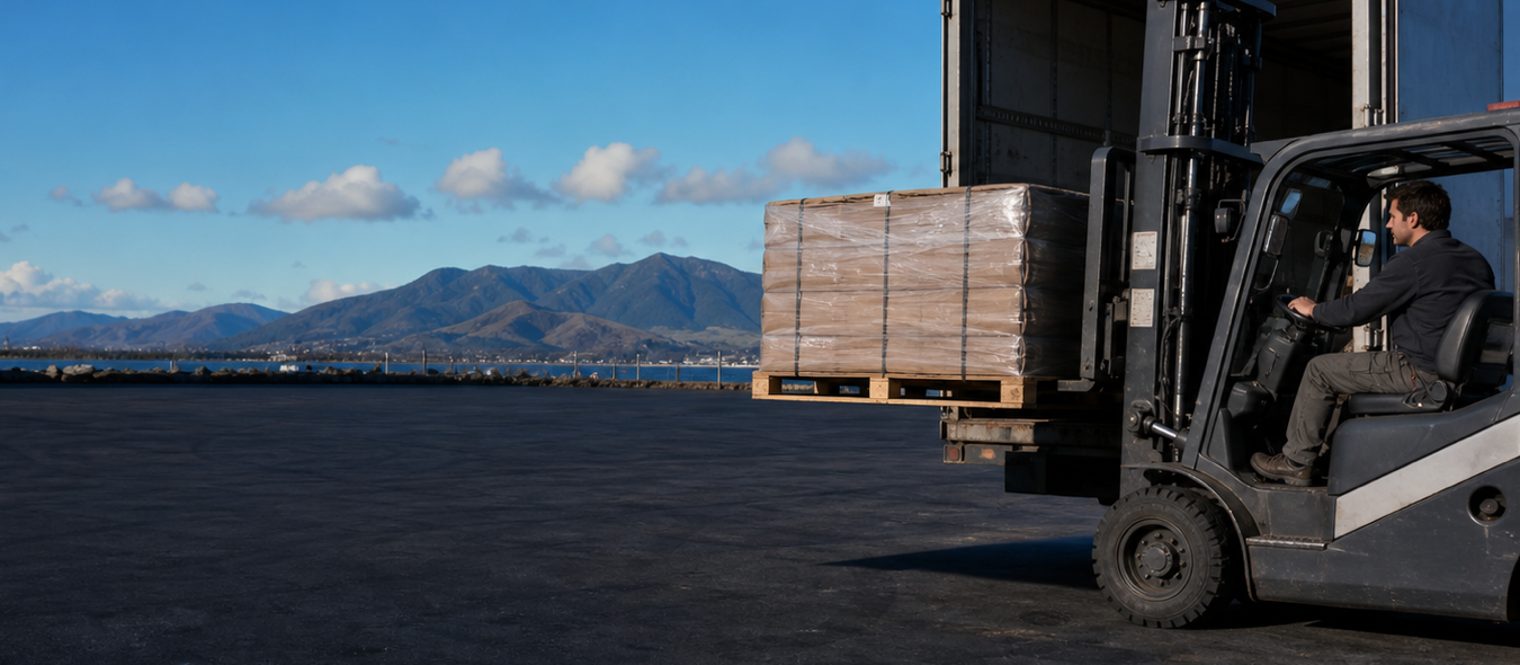
If a forklift is driven on a road, the operator needs a forklift (F) endorsement on their driver licence. The requirement comes from clause 28 of the Land Transport (Driver Licensing) Rule 1999, read with Schedule 4, which lists "F, Forklift endorsement for use with special-type vehicles that are forklifts". It is administered by NZTA and enforced by NZ Police, and it has nothing to do with workplace competency.
The unit standard for the endorsement course says so itself. Unit standard 18496 carries a note that achieving it "does not meet the training requirements to operate a forklift" under health and safety law, and a second note that achieving it by itself does not entitle the holder to drive a forklift on a road, because the endorsement still has to go on the licence.
- You need a full driver licence first, other than a motorcycle licence.
- Class 1 covers forklifts with a gross laden weight of 18,000kg or less. Gross laden weight means the machine plus the load.
- Class 2 is required above 18,000kg.
- You complete an NZTA approved course, then apply at a driver licensing agent on form DL19 with evidence of identity, the course certificate and an eyesight check. The fee is $62.10.
- The endorsement expires with your driver licence and renews with it. There is no separate retest.
Two traps here. First, NZTA is explicit that the approved course "will cover driver licensing requirements only" and that your employer may still require occupational safety training as well. Second, holding the course certificate is not the same as holding the endorsement. NZTA's own wording: you cannot drive a forklift on the road just because you have the course certificate.
"We are on private property, so this does not apply to us"
This is the assumption most likely to catch a New Zealand business out. The definition of "road" in section 2(1) of the Land Transport Act 1998 is deliberately wide. Road includes:
- a street
- a motorway
- a beach
- a place to which the public have access, whether as of right or not
- all bridges, culverts, ferries and fords forming part of any of the above
- all sites at which vehicles may be weighed under the Act
The fourth limb is the one that does the work, and NZTA's guidance spells out how far it reaches. On its forklift endorsement page NZTA says the definition includes "any place the public has access to (by right or not) including bridges, culverts, beaches, riverbeds, reserve lands, wharves and road shoulders", and then adds, in as many words, that a factory yard with no gate may also fit this definition. Note that the riverbeds, wharves and reserve lands in that list come from NZTA's guidance. The statutory wording does not name them. They are examples of places the public can get to, not separate categories in the Act.
If your yard is open to the street, or a customer can drive in to collect an order, do not assume you are outside the road rules. A forklift driven on a road also has to be registered, hold a warrant of fitness, and may need an alternative fuel certificate.
The unit standard has changed, and there is a deadline
If your training paperwork references unit standard 10851, Operate a powered industrial lift truck (forklift), that standard has been replaced by skill standard 40735, Operate a forklift safely, registered on 24 July 2025. The last date for assessment against 10851 is 31 December 2027.
The separate standard for the road endorsement course is unit standard 18496, Demonstrate knowledge and skills for driving a forklift on a road for endorsement F, which remains current.
Worth checking what your provider is actually assessing against, because a good deal of published material still names 10851 as though nothing has changed.
What is changing in 2027, and what is not
The Health and Safety at Work Amendment Act 2026 received Royal assent on 9 July 2026 and comes into force on 1 April 2027. It strengthens the safe harbour status of approved codes of practice, so that following an approved code for a specific risk means a duty holder is treated as having met their duty for managing that risk.
It is worth being careful about what this does for forklifts, because it is easy to overstate. Only two existing codes are expected to carry deemed compliance from commencement: the Ports code approved in 2024 and the Forestry code approved in 2025. Every other existing code, the 1995 forklift code included, keeps its current evidential status until it is reviewed and reapproved by the Minister.
So on 1 April 2027 the forklift code's legal weight does not change. It remains admissible evidence of what was reasonably practicable, which is still a good reason to follow it. The change to watch is that third parties can now put forward draft codes, so a modern forklift code with genuine safe harbour behind it becomes possible in a way it was not before.
Myths worth retiring
- "You need a forklift licence." No such thing exists in New Zealand law.
- "An F endorsement means you are trained to operate." NZTA says the course covers driver licensing requirements only.
- "A car licence is enough." The code of practice states that holding a driver licence is not sufficient evidence that a person is qualified to operate a forklift.
- "My certificate lets me drive on the road." It does not. You need the endorsement on your licence.
- "Trained once, trained forever." The duty is that training remains suitable and adequate for the work as it is now.
- "WorkSafe requires a unit standard." It does not. WorkSafe's own page says the code of practice sets out training that should be provided. The duty is competency and evidence of it.
What this costs when it goes wrong
WorkSafe has been blunt about forklifts for years. In a June 2017 media release it reported 16 serious incidents involving forklifts in the preceding eight weeks, and its then chief executive said forklifts "have been killing and maiming people for many years, yet there is little evidence the risk they pose is being identified, let alone appropriately managed". Inspectors specifically found a lack of operator training.
In one prosecution following a 2016 fatality, Toll Networks (NZ) Ltd was fined $506,300 with reparations of $118,020.10 on top of $105,000 already paid. Those numbers are not the reason to train people properly, but they are a fair measure of what the duty is worth.
Where training fits
Training is one control among several. It does not make a business compliant on its own, and no course can. Segregating people from machines, fixing sightlines, sorting out pedestrian routes and slowing traffic down all sit higher in the hierarchy than telling an operator to be careful.
Where awareness training earns its place is with everyone who is not the operator. Most forklift harm in a warehouse happens to people on foot. Our Forklift Awareness course is built for that audience, the team working around the machine. It pairs with hands-on operator training and does not replace it.
If you are also sorting out the wider picture, Introduction to Health and Safety covers how the duties in this article fit together, and Manual Handling for Staff covers the injuries that happen when the forklift is not available and someone lifts it anyway.
Common questions
Is there a forklift licence in New Zealand?
Is it WorkSafe or NZTA that requires the F endorsement?
Does WorkSafe require a unit standard to operate a forklift?
But does not the code of practice say no one shall operate a forklift without a certificate?
When do I need an F endorsement?
Does the F endorsement mean I am trained to operate a forklift?
Is forklift refresher training every three years a legal requirement?
Do the road rules apply in our own yard?
Is the 1995 forklift code of practice still relevant?
Are we legally required to keep forklift training records?
Training the people who work around the machines
Most forklift harm happens to people on foot. Forklift Awareness is built for the whole team, including the people working around the machine.
See Forklift Awareness